

The Realization
Requisite Agility began with a simple observation: traditional approaches to agility were failing in the face of complexity.
Organizations were becoming faster, but not necessarily wiser. They were adapting to surface-level changes while missing the deeper systemic shifts reshaping their industries and societies.
Requisite Agility emerged as a response to this gap that forms a way to connect speed with sensemaking, and adaptability with purpose.
Early Foundations
The concept took shape through a synthesis of systems thinking, complexity science, organizational design, and adaptive leadership.
It recognized that every organization must learn to adapt itself to operate at the intersection of stability and disruption while continuously sensing, learning, and evolving in real time.
RA was never intended to be another framework or methodology. It was envisioned as a living capability, helping organizations remain coherent amid transformation.
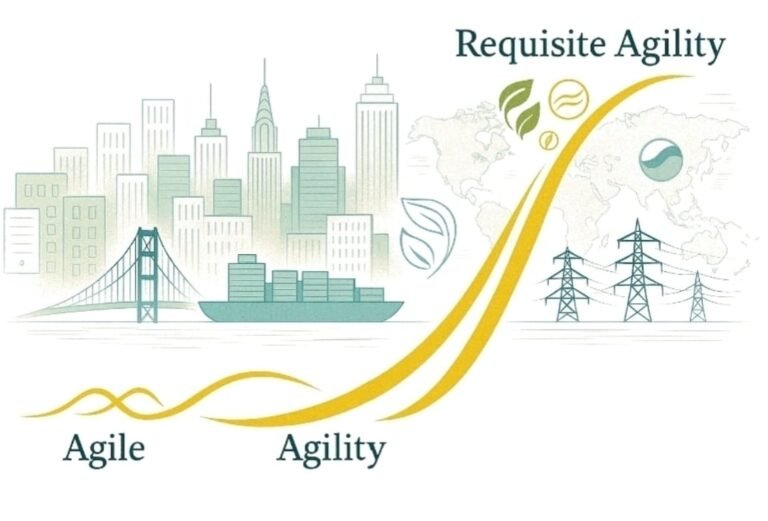
From Agile to Requisite Agility
Traditional agile practices focused on iteration, speed, and flexibility which was important but often limited to short-term efficiency.
Requisite Agility built on these foundations and went further, shifting from adapting to change toward designing work systems that automatically respond to change.
It focuses on how well-designed systems can learn, renew, and transform continuously, rather than rigid systems that react to disruption in fragments.
The shift is from doing agile to being adaptive.
The New York Conference: A Movement Begins
The first Requisite Agility Conference in New York (2019) brought together global experts in organizational design with one goal: to bridge fragmented schools of thought and build a more integrated, human-centred approach to transformation.
Since then, RA has become a trusted learning network for leaders seeking to build self-designing organizations that perform in the short term without sacrificing adaptability or purpose.
A Global Community in Motion
Since its inception, Requisite Agility has brought together executives, change agents, and system thinkers exploring how organizations can be designed to perform, adapt, and regenerate in a rapidly changing world.
It has become a trusted learning network for leaders seeking to achieve short-term business and financial performance without losing long-term adaptability, integrity, or purpose.
RA has found application across:
Where RA is Going Next
Today, RA is at the forefront of reshaping how organizations, industries, and societies function in a complex world.
RA continues to evolve, integrating AI, regenerative business models, and transdisciplinary innovation to create new possibilities for the future.